



Blog, Cat, English Blog
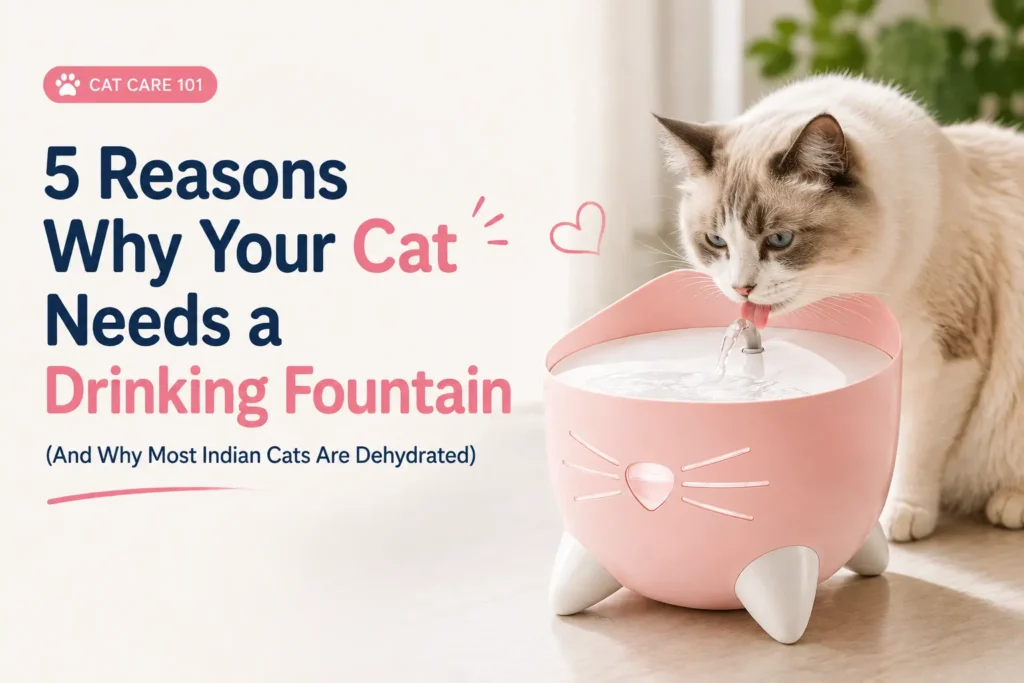
5 Reasons Why Your Cat Needs a Drinking Fountain (And Why Most Indian Cats Are Dehydrated)
Aug
Most cat parents don’t realise it, but a huge number of indoor cats in India simply don’t drink enough water — and it’s one of the most common reasons vets see kidney and urinary problems in cats. The good news?
A cat drinking fountain can fix this almost overnight. Here’s why.
1. Cats Are Built to Get Water From Food, Not Bowls
In the wild, a cat’s ancestors got most of their hydration from prey — not from standing around a water source. That instinct hasn’t gone anywhere.
Modern indoor cats, especially those on dry kibble, don’t have that natural moisture intake anymore.
which means they need to actively drink water to make up the difference — something most cats are simply not wired to do on their own.
This is exactly why so many Indian cat parents say “meri billi paani hi nahi peeti” — it’s not fussiness, it’s biology
2. Dehydration Is a Direct Path to Kidney and Urinary Disease
When a cat doesn’t drink enough, the minerals in their urine become concentrated and start forming crystals. The root cause of feline urinary tract disease and kidney stones.
Two of the most common (and most expensive) vet visits for cat owners. Indian tap water is often hard, with high calcium and magnesium content, which makes this worse.
This is where filtration matters: a fountain like the Catit PIXI Smart Water Fountain uses triple-action filtration plus a UV-C clarifier to actively pull out calcium, magnesium, and impurities before your cat drinks — something a steel bowl simply cannot do.
3. Cats Struggle to Judge Water Level in a Bowl
Cats have excellent eyesight but genuinely poor depth perception when it comes to a flat, still surface- which is why a bowl often looks “empty” to a cat even when it isn’t.
What cats are extremely good at is hearing and reacting to movement. The sound and motion of running water is instantly more noticeable to a cat than a silent bowl.
This is the entire logic behind adjustable-flow fountains — options like the Catit Drinking Flower Fountain offer multiple flow settings (calm pool, gentle stream, bubbling top) so even the pickiest cat finds a style they respond to.
4. Cats Instinctively Distrust Still Water
In nature, still water is where bacteria breeds- so cats have an ingrained wariness of stagnant water, even in a spotless bowl at home.
Moving water reads as “safe” to a cat on an instinctual level- which is a big part of why fountains see far higher usage than bowls,
even when the bowl is refresh daily.
For multi-cat homes, a larger-capacity option like the Catit Flower Fountain – Stainless Steel is worth it-
steel stays more hygienic and is easier to keep bacteria-free than plastic in Indian household conditions.
5. Whisker Fatigue Is Real — and Bowls Cause It
A cat’s whiskers are packs with nerve endings and constantly feeding it spatial information.
Repeated contact with the sides of a narrow bowl can cause genuine discomfort, known as whisker stress. leading some cats to avoid the bowl
altogether or paw water out onto the floor instead of drinking normally.
Fountains are deliberately designe with wide, shallow drinking areas so whiskers never touch the sides.
one more reason cats naturally gravitate toward them over traditional bowls.
The Easiest Fix: Get a Fountain That Also Feeds
If you want to solve hydration and mealtime habits in one go, the Premium Cat Fountain and Multi Feeder Combo pairs the Catit PIXI Fountain with a slow-feeder bowl. Great for cats that both gulp water rarely and eat too fast.
And don’t forget the consumable side — filters need regular replacement to keep filtration effective.
Bottom line : if your cat is a light drinker, it’s not a personality trait —
it’s a design problem with the bowl. A drinking fountain fixes it in days, not weeks.